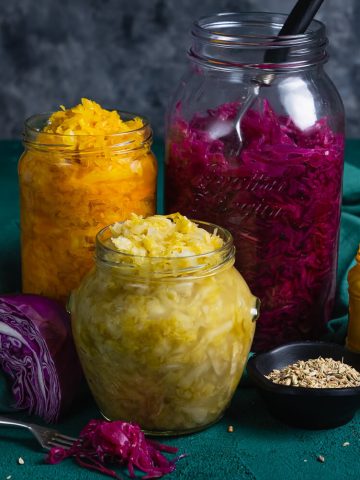
Homemade Sauerkraut Recipe - 3 Ways
Homemade sauerkraut is an excellent food rich in vitamin C and full of probiotics. It goes great with a variety of meats and legumes. I'm bringing you 3 recipe ideas for homemade sauerkraut that you'll absolutely love!
Ingredients
Basic sauerkraut
- 1 kg green cabbage (finely grated and chopped)
- 25 g sea salt
Hot & spicy sauerkraut
- 1 kg green cabbage (finely grated and chopped)
- 25 g sea salt
- 1 teaspoon turmeric powder
- ½ teaspoon hot paprika powder
- ½ teaspoon ginger powder
- ½ teaspoon fennel seed powder
Funky red cabbage sauerkraut
- 1 kg red cabbage (finely grated and chopped)
- 25 g sea salt
- 1 clove garlic (minced)
- ½ teaspoon ground black pepper
- ½ teaspoon ground coriander seeds
- ½ teaspoon ground mustard seeds
Instructions
- Remove the damaged, outer leaves of the cabbage, wash the cabbage head, and drain from water. Cut it into quarters, then finely grate (I recommend using a mandolin).
- Transfer the shredded cabbage to a large bowl, add salt, and start massaging the cabbage with your hands to let it release as much water as possible.
- After 10 min, the cabbage should have already released a lot of water, softened, and shrunken in size a lot. If you are making one of the versions with spices, now you can add your spices and massage it for an additional 2-3 minutes. Transfer the sauerkraut mixture to clean, dry jars so that you leave at least 6-7 cm to the opening. Add the rest of the brine so that all cabbage is covered in it.
- Take a clean plastic bag (I'm using a zip bag) prefilled with some tap water and carefully place it as a weight in a jar. All cabbage needs to be immersed in the brine. It's not necessary to close the jar with a lid.
- Leave it in a darker place, at a temperature between 16-24 Celsius (60-75 Fahrenheit). Every once in a while check how the fermentation is making progress. Sauerkraut is ready for consumption when you're happy with how it tastes.
- Transfer the sauerkraut to the fridge to slow down the fermentation.
Notes
- Depending on the type of cabbage, the time of the year when it was harvested, and its freshness, there is a possibility that during the massaging of cabbage with salt it may not release enough liquid. It rarely happened to me, but it is possible. Don't worry about it: you can dissolve some salt in additional water and then add it to a jar. However, it's important to maintain a good ratio of salt and water. Follow this formula: (water in grams) x 2.5/100. For example, if you need 200 g of water, multiply 200 by 2.5 and divide by 100 and the result will be 5 g.
- Make a note of the date when fermentation started. The easiest way to do this is to write it on a sticker and put it on the jars.
Tried this recipe?Let us know how it was!
Nutrition
Serving: 1servingCalories: 28kcalCarbohydrates: 7gProtein: 1gFat: 0.2gSaturated Fat: 0.03gPolyunsaturated Fat: 0.05gMonounsaturated Fat: 0.04gSodium: 990mgPotassium: 199mgFiber: 2gSugar: 3gVitamin A: 438IUVitamin C: 44mgCalcium: 44mgIron: 1mg
Nutritional information provided is an estimate based on ingredients data and should be used for informational purposes only. Actual nutritional content may vary based on factors such as portion size, preparation methods and ingredients used.